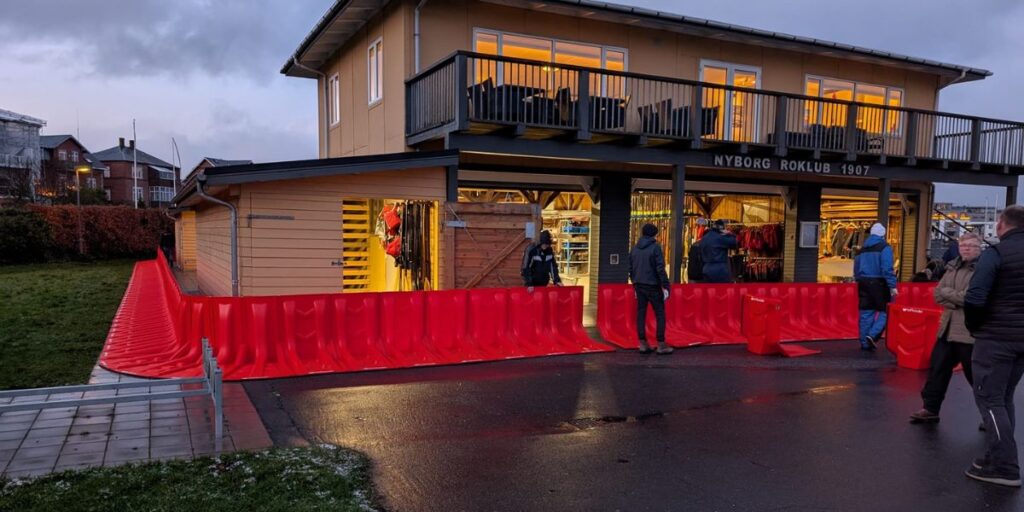
When Hurricane Harvey dumped over 50 inches of rain on Houston in 2017, entire neighborhoods disappeared underwater.
Traditional sandbags failed within hours, turning into soggy, useless barriers that offered false hope rather than real protection.
Sadly, this scene repeats itself worldwide – from flash floods in urban centres to storm surges along coastlines and river overflows that devastate communities in minutes.
Having spent over two decades in flood protection, we’ve seen the same tragic pattern play out countless times – communities relying on outdated methods that simply can’t handle today’s extreme weather events.
The Modern Solution – Flood Walls
This is where properly engineered flood walls come into play.
Unlike sandbags that absorb water and eventually fail or concrete barriers that crack under pressure and thermal stress, modern flood wall systems are designed with precision engineering principles.
They create a true water-tight seal and can be deployed rapidly when time is critical.
The best flood protection walls combine lightweight materials with exceptional strength, modular design for versatility and reusability that makes them cost-effective over time.
This makes them not just barriers but comprehensive flood management systems.
Warning! Not All Flood Walls Are Created Equal
Here’s what most people don’t realize – the flood wall market is filled with solutions that look similar on the surface but perform vastly differently when floodwaters rise.
Some use inferior materials that degrade quickly, while others rely on complicated installation processes that fail under pressure, literally and figuratively.
The difference between an adequate flood wall and an exceptional one often comes down to engineering details that aren’t obvious until you’re facing a real emergency.
Seal integrity, structural load distribution, foundation requirements and deployment speed all matter tremendously when lives and property are at stake.
This guide will walk you through the essential features that separate effective flood protection from expensive disappointments.
You’ll learn why EasyWall represents a fundamental shift in flood wall design by combining rapid deployment, superior materials and proven performance to redefine what’s possible in flood protection.
But first, let’s look at what it is, how it works, the different types that exist and how it differs from other systems.
What Is a Flood Wall?
A flood wall is a temporary or permanent vertical barrier system specifically engineered to prevent floodwater from reaching protected areas.
Unlike makeshift solutions, a proper flood wall creates a watertight seal that can withstand significant pressure while maintaining structural integrity throughout a flood event.
At its core, it serves one critical purpose – creating an impermeable vertical barrier that stops water at a predetermined height.
The best systems achieve this through precision-engineered components that interlock seamlessly, eliminating the weak points that cause traditional barriers to fail.
How Does a Flood Wall Work?
Basic Mechanics: Understanding Hydrostatic Pressure
When water accumulates against any barrier, it exerts hydrostatic pressure, a force that increases with depth.
This means that the deeper the water, the harder it pushes against the bottom of the barrier.
Hence, flood walls face their greatest stress at the base, not the top.
If a barrier isn’t engineered for this kind of pressure, it will usually fail from the bottom up.
That’s why having a strong design and reliable sealing at the base are absolutely critical in any high-performance flood wall.
Generally speaking, effective flood protection walls must resist three specific forces:
- Lateral pressure pushing horizontally against the barrier
- Overturning moments trying to tip the structure backwards, and
- Uplift forces that can literally float inadequately anchored systems.
Any flood wall that doesn’t address all three will fail under real-world conditions.
Sealing and Anchoring: The Critical Interface
The ground interface is where most flood protection systems fail and it’s where engineering expertise becomes absolutely critical.
Foundation sealing requires creating a watertight connection between the flood wall base and the ground surface.
Premium systems use flexible sealing membranes or gaskets that conform to surface irregularities found in concrete, asphalt, compacted earth or even moderately uneven terrain.
The seal must remain intact even as hydraulic forces try to lift or shift the barrier.
“A flood wall is only as good as its ground seal”
A barrier that’s watertight between panels but leaks at the foundation is essentially useless.
The water will simply flow underneath, rendering your entire investment meaningless.
Anchoring mechanisms prevent the flood wall from sliding, tipping or floating when pressure builds.
Different systems use different approaches:
- Weight-based anchoring relies on the mass of the flood wall system itself, often enhanced with water or sand ballast that adds weight exactly where needed most.
This approach works well for temporary deployments on solid surfaces.
- Mechanical anchoring uses ground stakes, foundation bolts or specialized anchors that physically lock the system to the substrate.
These provide superior resistance to overturning forces but require proper installation and compatible ground conditions.
- Hybrid systems combine weight and mechanical anchoring to optimize performance across varying conditions.
This is generally the most reliable approach for serious flood protection.
The ground surface matters enormously.
Smooth, level concrete provides ideal conditions where seals can achieve maximum effectiveness.
Uneven or porous surfaces require more sophisticated sealing solutions and often additional anchoring.
Structural Features: Engineered for Real-World Performance
Beyond sealing and anchoring, the structural design of the flood wall itself determines whether it will maintain integrity under load.
Panel interlocking systems create continuous barriers from modular components.
The connection points between panels are critical vulnerability zones.
Superior designs use multiple overlapping seals and mechanical interlocks that actually strengthen under pressure rather than weakening.
Think of it like a zipper that tightens as force increases – physics works with you, not against you.
Load distribution involves spreading hydraulic forces across the entire structure rather than concentrating stress at specific points.
This is achieved through engineered cross-sections, internal reinforcement and strategic material selection.
Bracing and support systems prevent flexing or bowing when water pressure builds.
Vertical supports placed at calculated intervals transfer loads downward into the foundation rather than allowing the barrier to deform.
The spacing and strength of these supports must match the expected hydraulic loads; undersizing them is a common failure point in inferior systems.
Material properties directly impact performance. The material must be impermeable, structurally rigid under load and durable through repeated deployments.
Height considerations affect stability exponentially, not linearly.
Doubling the height of a flood wall roughly quadruples the overturning forces due to the triangular pressure distribution.
This is why taller flood protection walls require more substantial anchoring and bracing – the physics becomes increasingly demanding as height increases.
The best flood wall designs integrate all these elements into a cohesive system where each component reinforces the others.
When properly engineered, a flood protection wall doesn’t just resist water – it becomes stronger and more stable as pressure increases, with seals tightening and structural elements loading in ways that enhance rather than compromise integrity.
Different Types of Flood Walls
- Permanent Flood Walls
Concrete and masonry flood walls are engineered structures built into the landscape, typically protecting entire neighborhoods or industrial zones.
They’re effective for long-term regional protection but come with significant drawbacks e.g. construction costs can reach hundreds of dollars per linear foot, environmental disruption and zero flexibility once installed.
Sheet piling systems involve driving interlocking steel or composite sheets deep into the ground to form continuous barriers.
This method works exceptionally well where deep flood protection is needed or soil conditions make traditional concrete walls impractical.
Crest walls serve a specialized purpose i.e. adding height to existing levees or embankments without expanding their footprint.
When communities outgrow their original flood protection design, something increasingly common with changing weather patterns, crest walls provide a practical upgrade path.
- Temporary and Demountable Flood Barriers
Sandbags remain the default for unprepared communities, despite being labor-intensive, messy and surprisingly ineffective.
A single 50-foot barrier requires over 1,000 sandbags and hours of backbreaking work.
They leak constantly, deteriorate quickly and create disposal problems after each event.
Water-filled and inflatable barriers require pumping systems and their setup complexity increases with barrier length. One failure point can compromise the entire system.
Metal and polymer panel systems offer better performance than sandbags but often suffer from weight issues requiring equipment for installation.
They also get affected by seal degradation over time and need complex assembly procedures that fail under time pressure.
Many use gasket systems that don’t adapt well to uneven surfaces.
Modular boxwall systems represent the evolution of temporary flood protection.
These engineered solutions like EasyWall use interlocking modular units that create watertight barriers through simple stacking.
They’re lightweight enough for rapid manual deployment yet structurally sound enough to handle serious hydraulic loads.
The modular approach provides flexibility that fixed systems can’t match while delivering reliability that other temporary solutions consistently fail to achieve.
Overall, the right choice depends on your specific needs but for most applications requiring rapid deployment and proven performance, advanced modular systems such as the EasyWall have fundamentally changed what’s possible in flood protection.
How Flood Walls Differ from Other Protection Systems
Too many people confuse flood walls with other water management systems.
Each serves different purposes and understanding these distinctions can mean the difference between effective protection and costly failure.
- Levees are permanent earthen embankments built along rivers and coastlines.
They’re massive permanent structures that require years to construct and significant ongoing maintenance.
While effective for large-scale regional protection, they’re impractical for most property-specific applications and can’t be adjusted or relocated.
- Dikes are similar to levees but are typically smaller earthen barriers.
They’re designed for long-term water control rather than emergency flood response.
Like levees, they’re permanent installations that can’t adapt to changing flood patterns or be deployed quickly.
- Sandbags represent the old guard of flood protection and frankly speaking, they’re woefully inadequate for serious flood events.
They absorb water, become unstable and create numerous leak points.
They also tend to collapse within hours, leaving communities defensively exposed when they need protection most.
- Dams are massive permanent structures designed to control water flow across entire watersheds.
While they provide regional flood control benefits, they’re infrastructure projects that take decades to plan and build, with environmental and regulatory complexities that make them unsuitable for localized protection needs.
5 Non-Negotiable Features of a High-Performance Flood Wall
The difference between a system that works and one that fails comes down to a few critical features.
If a flood wall doesn’t deliver on these five essentials, it’s simply not worth your trust.
1. Uncompromising Strength and Durability
Floodwater is heavy – just one cubic meter weighs about 2,205 lb (about 1 ton)
A reliable wall must use high-grade materials that resist water pressure, debris impact and repeated use.
2. A Watertight Seal Is Everything
Most failures happen at the seal, not the wall.
A top system locks tight to prevent seepage, even on uneven ground like cracked concrete.
3. Speed and Ease of Deployment
Floods rarely give advance notice. When the warning comes, you may have hours or sometimes just minutes to respond.
That’s why a flood-resistant wall must be quick to deploy, with no need for heavy machinery, special tools or large crews.
4. Long-Term Value and Reusability
Disposable sandbags add up in cost. A reusable wall is an investment – it lasts for years, requires little maintenance and pays for itself over multiple deployments.
5. Versatility for Your Property
Every site is different. A flood wall should adapt to curves, corners and mixed terrain without losing strength or watertightness.
The EasyWall Advantage: Engineered to Exceed Every Expectation
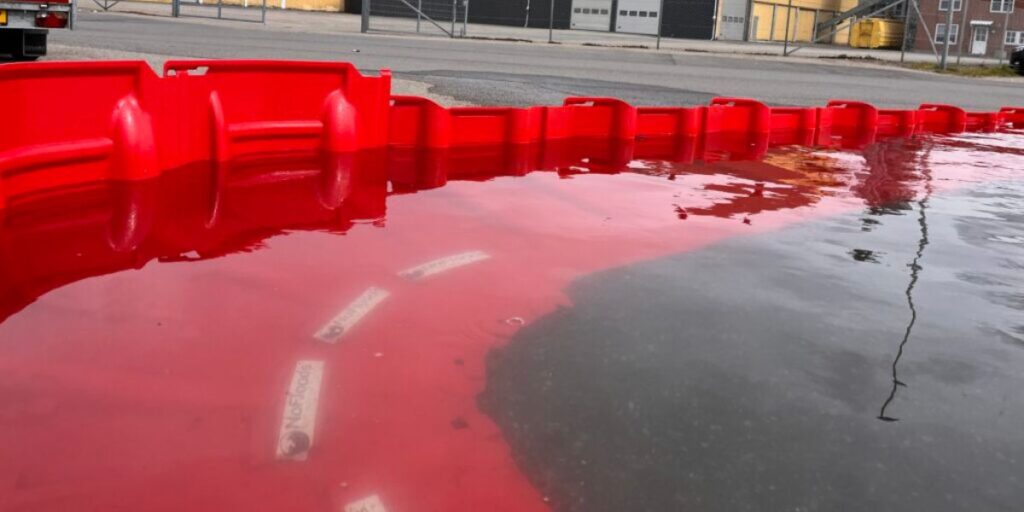
EasyWall isn’t just another flood wall, it’s engineered from the ground up to solve the real problems people face when water rises.
Every feature has been designed to meet and exceed the five non-negotiable standards of a high-performance flood protection wall.
Superior Structural Design & Materials
EasyWall’s modular units are made from durable ABS plastic with built-in UV protection, designed to withstand repeated exposure to sun, rain and extreme temperatures (-20°C to +35°C).
Despite their lightweight build, the units are tough, impact-resistant and engineered to withstand significant water depths without warping or shifting.
Proprietary Sealing Technology
A flood wall is only as good as its seal. EasyWall uses an integrated friction foam and precision-fit joints to form a watertight connection with the ground.
Even on uneven surfaces like cracked pavement, the barrier stays sealed and keeps water out.
Smart Self-Anchoring System
EasyWall’s clever L-shaped design uses the bookend water-ballast principle i.e. as water presses against the wall, it reinforces its own stability.
This means no external bracing, no bolts and no heavy foundations are needed – just place it and let the design work for you.
Lightweight and Tool-Free Setup
Weighing as little as 6 lb per unit (for the smallest unit), EasyWall can be deployed by a single person.
No tools, machinery or special training is required.
In a flood emergency, this speed can make the difference between safety and loss.
Modular and Stackable
Every unit locks seamlessly with the next, allowing you to build protection to the length you need.
Units stack neatly when not in use, making transport and storage efficient and space-saving.
Rapid Deployment in Minutes
Two people can deploy a significant line of defense in a fraction of the time it takes to set up sandbags or heavier barriers.
It’s as simple as place-and-go, ensuring protection is in place before the water arrives.
An Investment That Pays for Itself
Unlike sandbags which are single-use and messy, EasyWall is fully reusable.
Its durability and minimal maintenance needs mean lower lifetime costs, while its compact storage reduces logistical expenses.
Over multiple deployments, the savings are substantial.
Customizable Solutions for Any Site
Whether you’re protecting a home, storefront, municipal road or critical infrastructure, EasyWall adapts to your layout.
With straight, end, inward and outward corner modules, plus adjustable modules for an exact fit, it can follow curves, corners and complex terrain with ease—something other brands cannot match.
Protection heights range from 50 cm to 108 cm to suit your risk profile.
Proven Performance
EasyWall has been tested under demanding real-world conditions and complies with rigorous safety and engineering standards.
It has been proven in floods across different terrains and climates, giving property owners and municipalities confidence that they can rely on.
Discreet and Professional Appearance
Flood protection doesn’t need to look messy. EasyWall’s clean professional design provides robust defense without spoiling the appearance of your property.
Installation & Deployment Guide
Deploying the NoFloods EasyWall requires no specialized tools or technical expertise.
The interlocking design allows rapid assembly by one or two people, even under emergency time pressure.
Each barrier unit connects intuitively – simply position, interlock and secure.
This straightforward process means you can establish complete perimeter protection in hours, not days, when flood warnings demand immediate action.
For detailed deployment instructions and site-specific guidance, check out the official 4-step installation guide here.
EasyWall: Your Next Step Toward Unbreachable Flood Protection
The right flood wall decision comes down to five critical factors: uncompromising strength, watertight sealing, rapid deployment, long-term value and real-world versatility.
EasyWall delivers on every count with engineered UV-protected ABS construction, friction foam sealing technology, tool-free single-person assembly, decades of reusability and modular configurations that adapt to any property layout.
What sets EasyWall apart is its self-anchoring water-ballast design – the system actually becomes more stable as floodwater rises, using hydraulic pressure to enhance rather than compromise protection.
No external anchoring, no ground stakes and no complex installation is required, just intelligent engineering that works with the physics of flooding instead of fighting against it.
Whether you’re protecting 50 feet or 500 feet of perimeter, EasyWall’s straight sections and corner modules configure precisely to your site, with protection heights from 50 cm to 108 cm matching your specific flood risk.
With over twenty years in flood protection, we’ve learned one undeniable truth – the best time to establish your flood defense is before you need it!
Proactive preparation means having EasyWall staged and ready, not scrambling for solutions when flood warnings arrive.
Ready to protect what matters most? Get in touch with our team to discuss your specific protection needs, request a consultation or see EasyWall in action.
Contact us here to explore the complete system and discover why forward-thinking property owners across residential, commercial and municipal sectors are choosing EasyWall over outdated alternatives.
Your property deserves protection that works as intelligently as you do.
Make EasyWall your preferred flood wall defense strategy today.