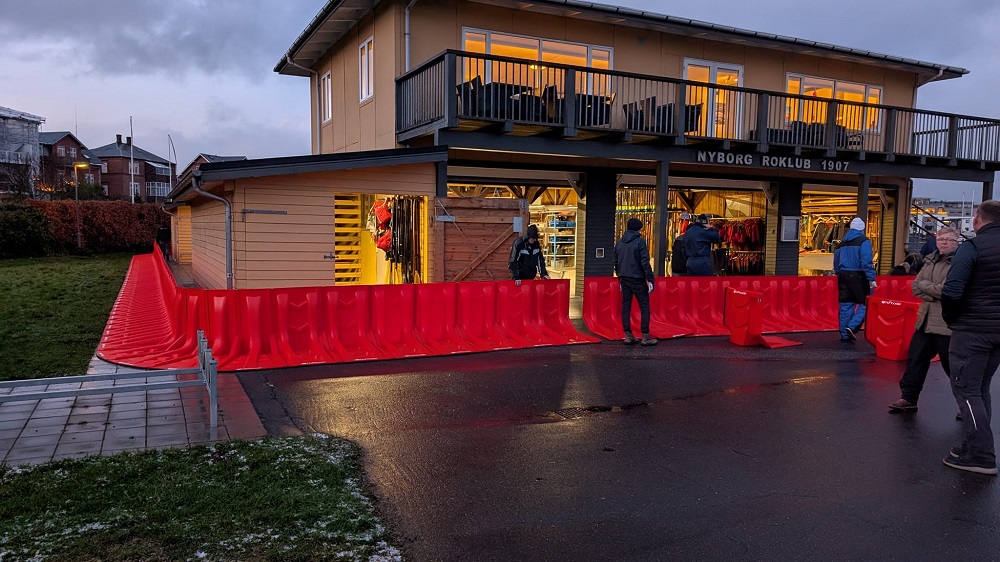
Flooding can strike quickly, leaving little time to protect homes, businesses and critical infrastructure.
Temporary water diversion barriers offer a fast, flexible and reliable solution to keep rising waters at bay.
But what exactly are these barriers, how do they work and which one is the best?
Let’s explore.
What Are Temporary Water Diversion Barriers?
Temporary water diversion barriers are portable and removable systems designed to redirect, contain or block floodwater during emergencies such as flooding, storm surge, burst pipes, infrastructure maintenance or construction projects.
They provide a fast, flexible and often reusable alternative to traditional methods like sandbags, offering rapid protection wherever it’s needed most.
These systems are engineered to give communities, municipalities and site managers the ability to respond quickly when water levels rise unexpectedly.
Their core purpose is to deliver temporary but highly effective flood protection without the cost, installation time or permanence of built-in defenses like levees or concrete walls.
They are typically made from durable lightweight materials, allowing them to withstand water pressure while remaining highly transportable.
Many modern systems use interlocking or self-stabilizing designs that rely on the water’s own force to stay in place, making deployment fast and manpower-efficient.
Types of Temporary Water Diversion Barriers
Temporary water barriers for flooding come in several forms, each built for different flood-protection needs.
1. Water-Filled Barriers (TubeBarriers, Watertubes)
These are long, flexible tubes made from durable material.
They are rolled out and filled with water (it can even be the floodwater itself).
The water’s weight anchors the barrier, creating a tight seal against the ground.
These are ideal for temporary cofferdams, dewatering and protecting large perimeters.
2. Rapid-Deployment Barriers (EasyWall)
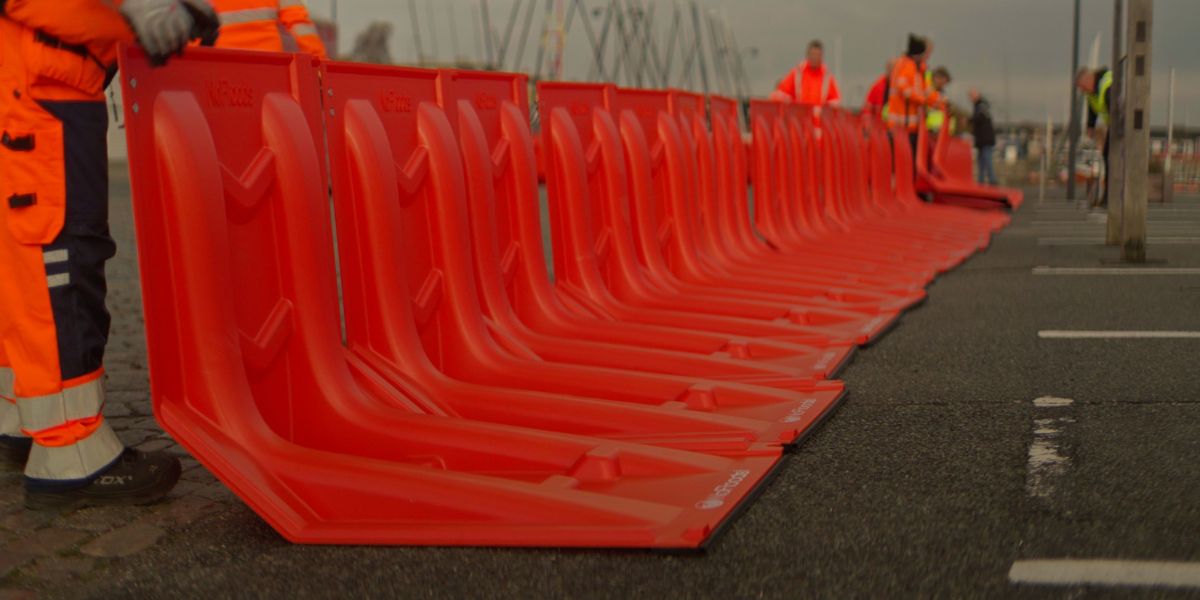
These are lightweight modular panels, often L-shaped, that use incoming water pressure to lock themselves in place.
They deploy quickly, require minimal manpower and are perfect for rapid response to flash floods or burst pipes.
EasyWall is a leading solution in this category.
3. Sandbags and Modern Alternatives
Traditional sandbags remain common but are slow to install and are labour-intensive.
Newer alternatives swell on contact with water, making them easier to transport and faster to use, though still less efficient than modern engineered systems.
Advantages of Temporary Water Diversion Barriers Over Permanent Defences
Compared to permanent flood defenses, temporary barriers for flooding offer several advantages e.g.:
- Flexibility: They can be installed exactly where and when needed.
- Cost-effectiveness: No major construction costs or ongoing maintenance.
- Rapid deployment: Ideal for emergency response teams and municipalities.
- Compact storage: They take up minimal space when not in use.
These barriers are widely used in scenarios such as:
- Flash flooding after heavy rainfall
- Coastal or harbor surge events
- River overflow during storms
- Redirecting surface water away from roads, buildings or critical infrastructure
- Protecting construction sites or low-lying areas during extreme weather
- Isolating sections of infrastructure during maintenance
How Do Water Diversion Barriers Work?
Water diversion barriers work by blocking or redirecting floodwater using engineered designs that create stability, form a watertight seal and resist rising water pressure.
Here’s more on that:
Self-Stabilizing Design
Modern systems like EasyWall rely on the “Bookend Principle” – the force of incoming water presses the barrier firmly into the ground.
The higher the water rises, the more stable the barrier becomes, eliminating the need for anchors or added weight.
Watertight Ground Seal
Barriers sit tightly against the ground and use interlocking connections to form a tight, continuous wall.
As pressure increases, the seal strengthens, forming a continuous and impermeable wall that minimizes seepage.
Modular and Interlocking Systems
Most modern water barriers, including EasyWall, use lightweight modular sections that:
- Connect quickly
- Bend around curves
- Scale to any length
- Deploy fast with small teams
This makes them ideal for rapidly changing flood conditions.
Note: All water diversion systems are engineered to resist hydrostatic pressure and control the movement of water.
Different Working Mechanisms
Depending on the system, these barriers may use self-stabilizing pressure, as in the case of EasyWall, or gravity and weight, as in the case of water-filled tubes.
Introducing EasyWall: A Smarter Water Diversion Barrier for Flooding
EasyWall, a new benchmark in the category of Boxwall and L-shaped Barriers, is a modern engineered solution for temporary flood protection.
Lightweight and stackable, it can be deployed quickly by small teams, making it ideal for urgent situations like stormwater surges, flash floods and coastal flooding.
Unlike traditional sandbags, EasyWall is reusable, sustainable and highly efficient, providing reliable protection while reducing labor and environmental impact.
Its modular design works on concrete, asphalt, compacted earth and moderately uneven surfaces, and can be configured to different barrier lengths.
This makes it a flexible long-term solution for communities, businesses and municipalities seeking fast, effective and sustainable flood control.
How to Deploy & Disassemble the EasyWall Water Diversion Barrier
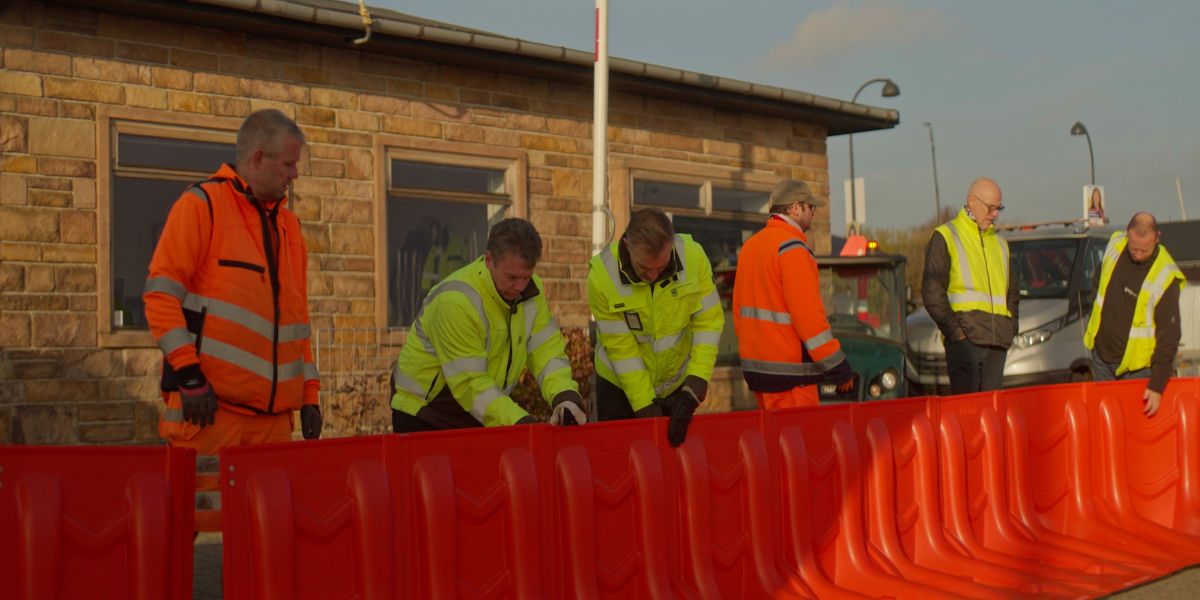
Deploying EasyWall is fast and straightforward, even for small teams.
Each module weighs 3–13 kg, making them easy to lift and position.
The intuitive locking system allows for rapid installation, while visual cues on each unit ensure correct orientation for maximum stability.
Step 1: Barrier Orientation
Each EasyWall module has a defined top and bottom.
Ensure the unit is upright using markings or shape cues to guarantee proper alignment and smooth connections with adjacent modules.
Step 2: Connecting Units
Place the first module in position, then tilt and align the next module’s bottom connectors before securing the top.
Repeat this process until the required barrier length is achieved.
Step 3: Locking and Configuration
The interlocking design allows for flexible adjustments.
Corner modules handle inward or outward turns while end modules provide a neat finish.
The system creates a secure and continuous flood barrier.
Step 4: Disassembly
Start from the end unit, unlock the top connection if required (depends on the model), then lift and tip each module to separate them.
EasyWall can be quickly removed, stored and redeployed whenever needed.
Case Study: Gentofte Municipality Invests In EasyWall to Protect Skovshoved Harbor from Storm Surges
When rising sea levels and increasingly unpredictable storm events intensified the risk along one of Denmark’s key coastal areas, Gentofte Municipality knew they needed a flood-protection solution that could act immediately, not years from now.
Their answer – the EasyWall water diversion system, deployed at scale to safeguard both Skovshoved Harbor and the surrounding neighbourhoods.
Here’s the entire breakdown:
The Challenge: Protecting a High-Risk Coastal Zone
Location: Skovshoved Harbor, Gentofte Municipality, Denmark
Skovshoved Harbor has become a priority focus area in Gentofte’s climate-adaptation program and for good reason.
The coastal zone faces mounting threats such as:
- Rising sea levels endanger harbor infrastructure and adjacent residential areas
- More frequent and intense storm-surge events driven by climate change
- Vulnerable neighbourhoods in close proximity to the waterfront with limited protection
With long-term coastal defenses still years away due to planning, engineering and environmental requirements, Gentofte needed a temporary water diversion system that could deploy quickly when storms approached and provide reliable protection without disrupting daily harbor activities.
Why Gentofte Chose EasyWall
Before choosing our system, Gentofte Municipality carried out extensive real-world testing of competing boxwall and L-shaped barrier systems.
The EasyWall quickly stood out for several critical reasons:
1. Technology That Sets a New Standard
EasyWall’s performance is anchored in two core innovations; the HydroSeal and HydroFoam.
Paired with a reinforced ABS structural design, these patented features deliver minimal seepage, tight ground sealing and unmatched reliability, setting a new benchmark among boxwall-style barriers.
2. Ultra-Fast Deployment When Seconds Matter
Flood events escalate quickly and EasyWall ensures you can respond just as fast.
- Rapid installation: Build long barrier lines far faster than sandbags or traditional barriers
- No tools or heavy machinery required: With a tool-free intuitive setup, teams can go from storage to full-scale protection in record time.
- Minimal manpower: One or two people can efficiently install extensive lengths
- No specialized training needed: Simple design enables fast onboarding and quick response
3. Designed for Simplicity, Built for Strength
EasyWall combines user-friendly handling with exceptional structural resilience.
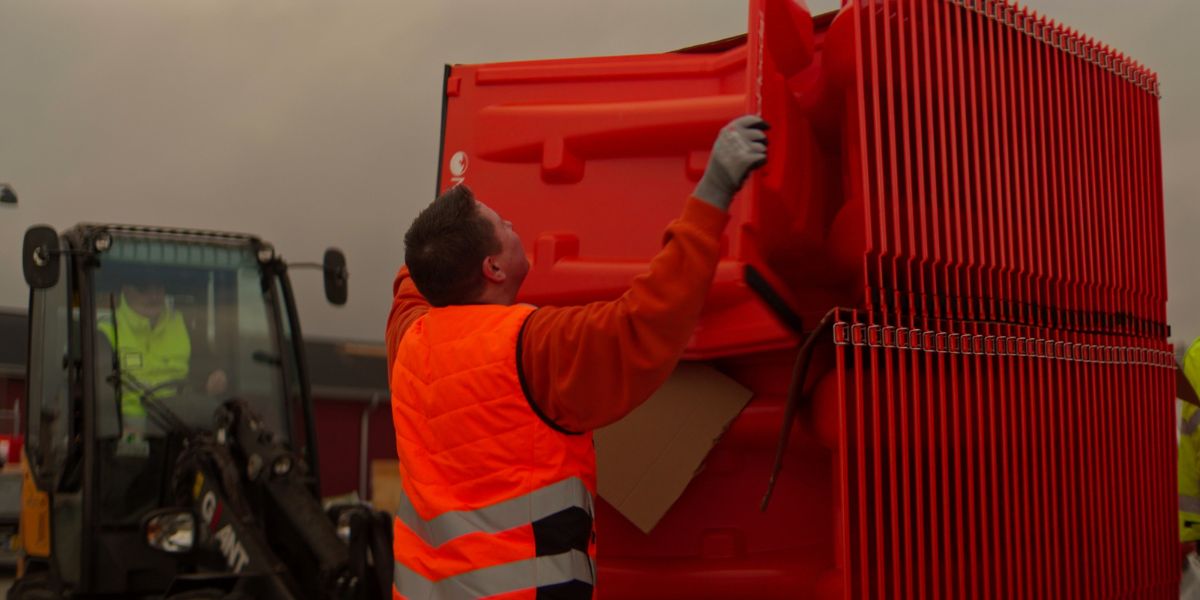
- Lightweight modular units: Easy to transport, position and connect over long distances
- Stackable storage: Compact footprint reduces facility and logistics costs
- Self-anchoring design: Water pressure automatically reinforces stability, no anchors or bolting required
- Exceptional stability: Stays firmly in place even under strong lateral forces
- Durable ABS construction: Tough, impact-resistant and engineered for repeated deployments
This balance of simplicity and strength ensures the barrier performs reliably even in demanding flood conditions.
4. Watertight Performance That Protects What Matters
EasyWall doesn’t just slow down water, it’s engineered to stop seepage and maintain continuous protection.
- More consistent than sandbags: Eliminates weak points caused by variable stacking
- Trusted during extended events: Maintains sealing integrity even in long-lasting floods
The result is peace of mind when water levels rise and pressure mounts.
5. Flexible Protection That Adapts to Any Site
Flood risks differ from one location to another. EasyWall adapts effortlessly.
- Modular system: Follows curves, corners and irregular layouts
- Scalable lengths: Ideal for small sites, large facilities or kilometer-long municipal defenses
- Multiple heights: From 50 cm to 108 cm to match varying risk levels
- Configurable setups: Create straight lines, L-shapes, U-shapes or complex perimeter defenses
This flexibility makes EasyWall suitable for coastal areas, urban roads, harbors, homes and commercial properties.
6. Long-Term Value and Cost-Effectiveness
EasyWall balances performance with economic efficiency.
- Fully reusable: Designed for years of repeated deployments
- Lower lifetime costs: Avoid waste and recurring sandbag expenses
- Reduces flood-damage risk: Pays for itself quickly by reducing costly losses
- Compact storage: Fewer storage requirements than heavy or bulky systems
7. Proven Performance You Can Trust
EasyWall is not theory – it’s proven under real pressure.
- It’s safe and stable to operate
- Trusted in active deployments
- Professional appearance: Clean, structured and unobtrusive
- Relied on worldwide: Municipalities, ports and businesses choose EasyWall when floodwater threatens
Its field-tested reliability gives teams the confidence to act decisively during emergencies.
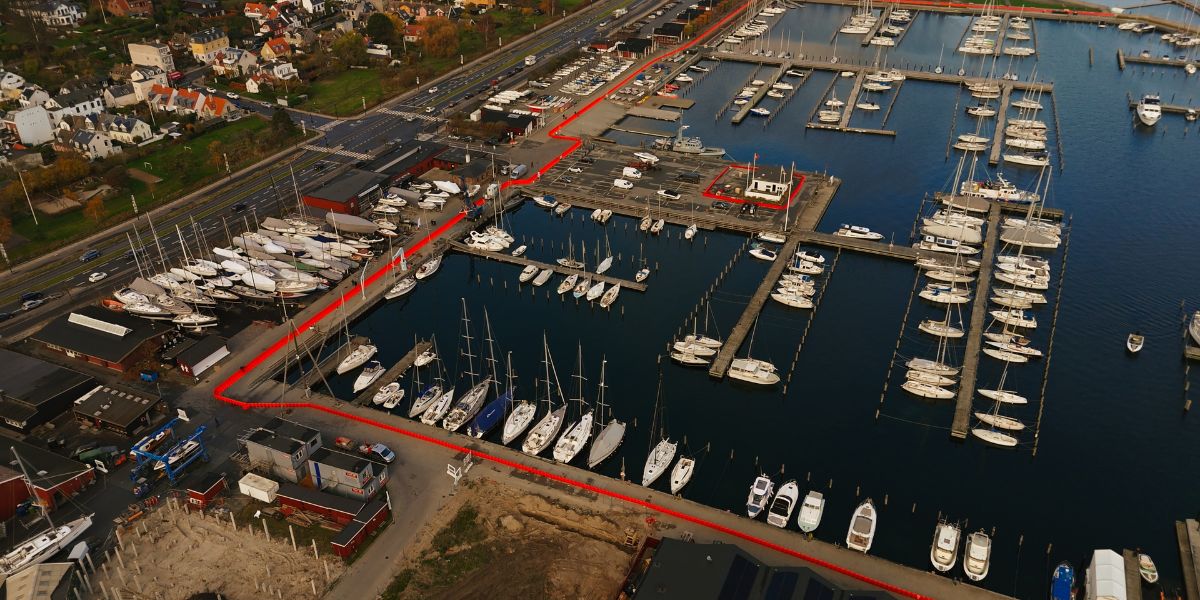
The Result: 1 Kilometer of Coastline Protected in 3 Hours
Gentofte Municipality’s comprehensive field deployment at Skovshoved Harbor didn’t just test the EasyWall water diversion system; it proved that effective coastal flood protection can be both rapid and reliable when it matters most.
Deployment Performance by the Numbers
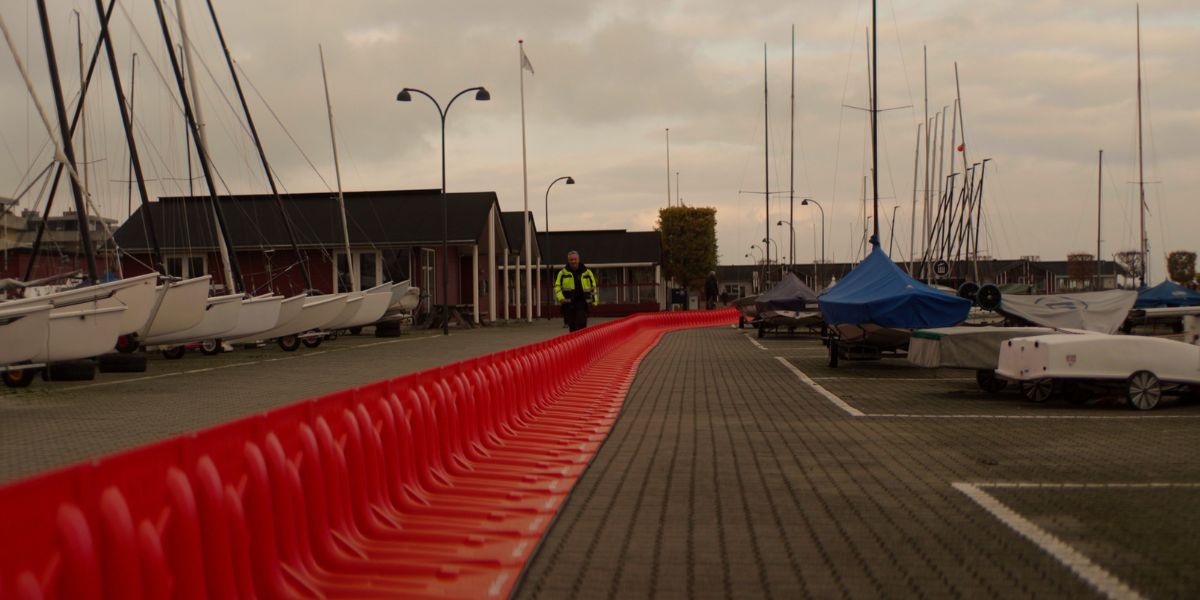
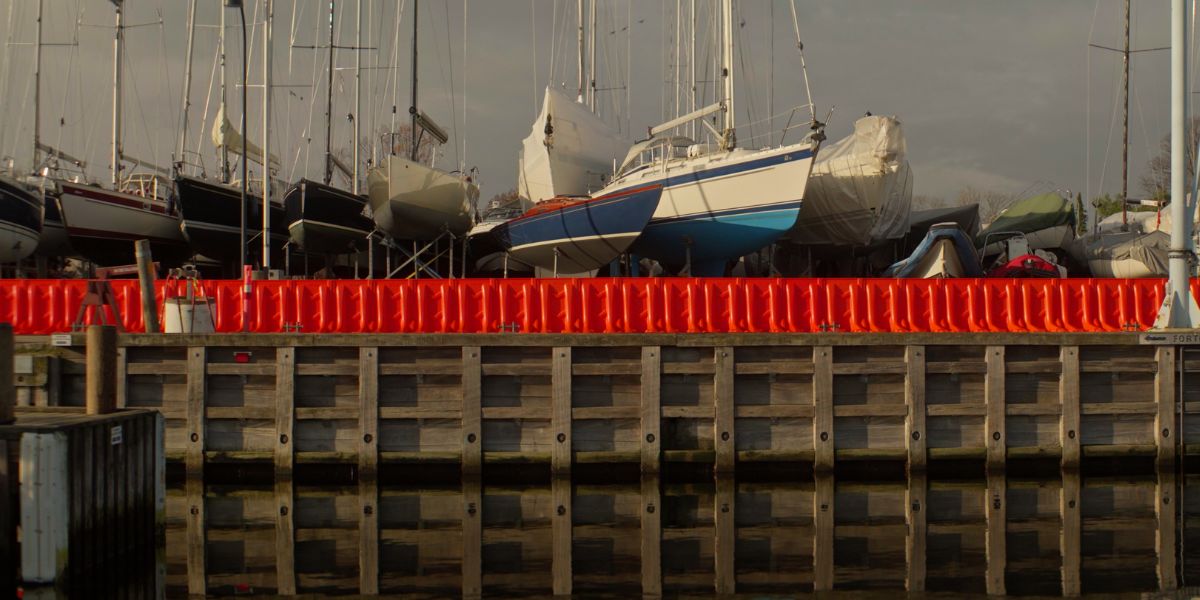
Coverage area: Approximately 1,000 meters (1 km) of coastal protection
Installation time: 3 hours for the complete barrier system
Removal time: 3 hours to clear the entire installation
Crew feedback: Teams praised the system’s speed, intuitive handling and overall ease of use
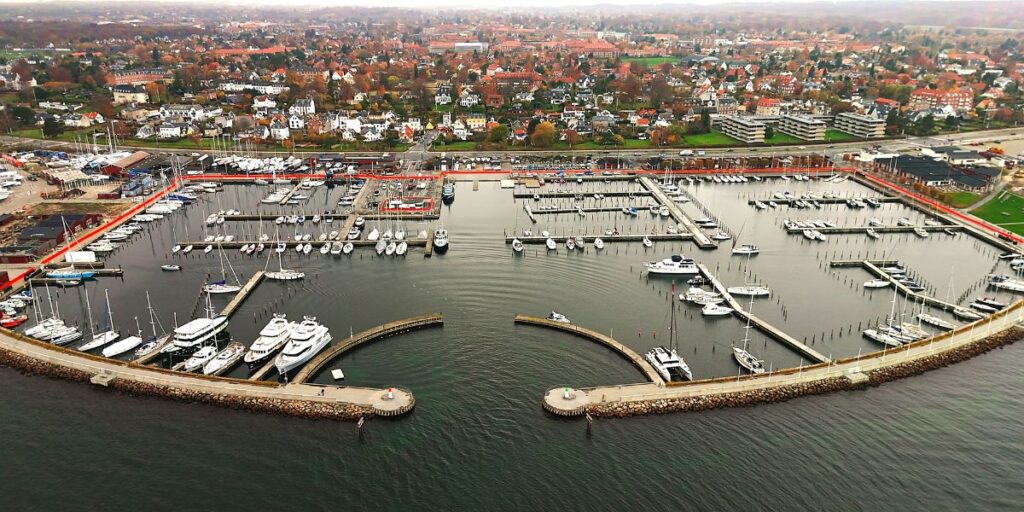
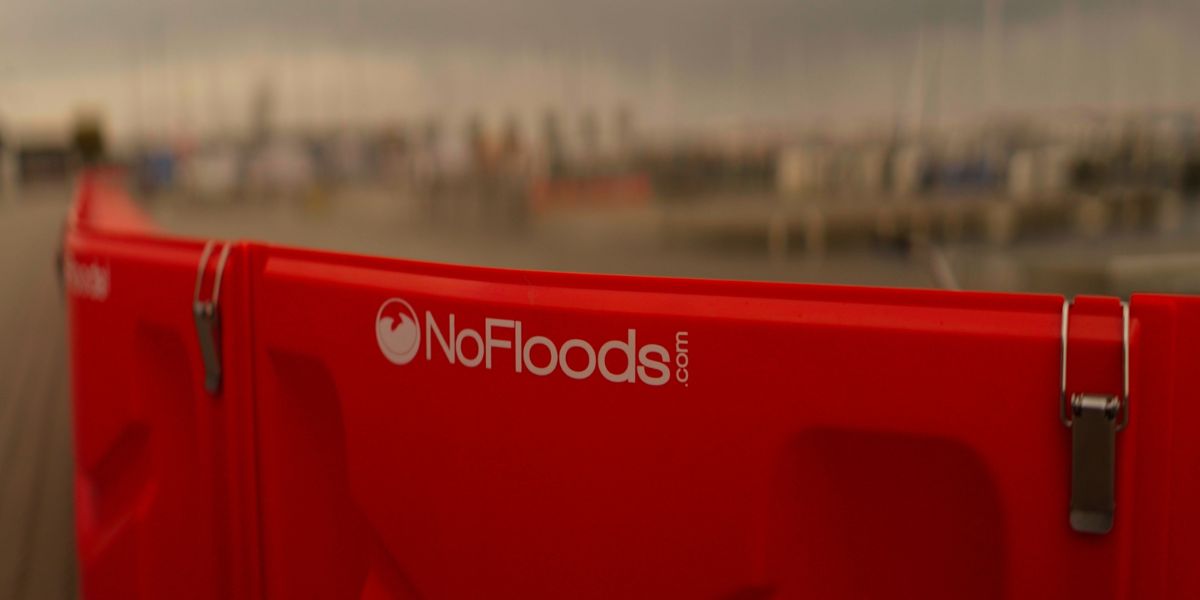
Here are a couple of pictures showing how the deployment went:
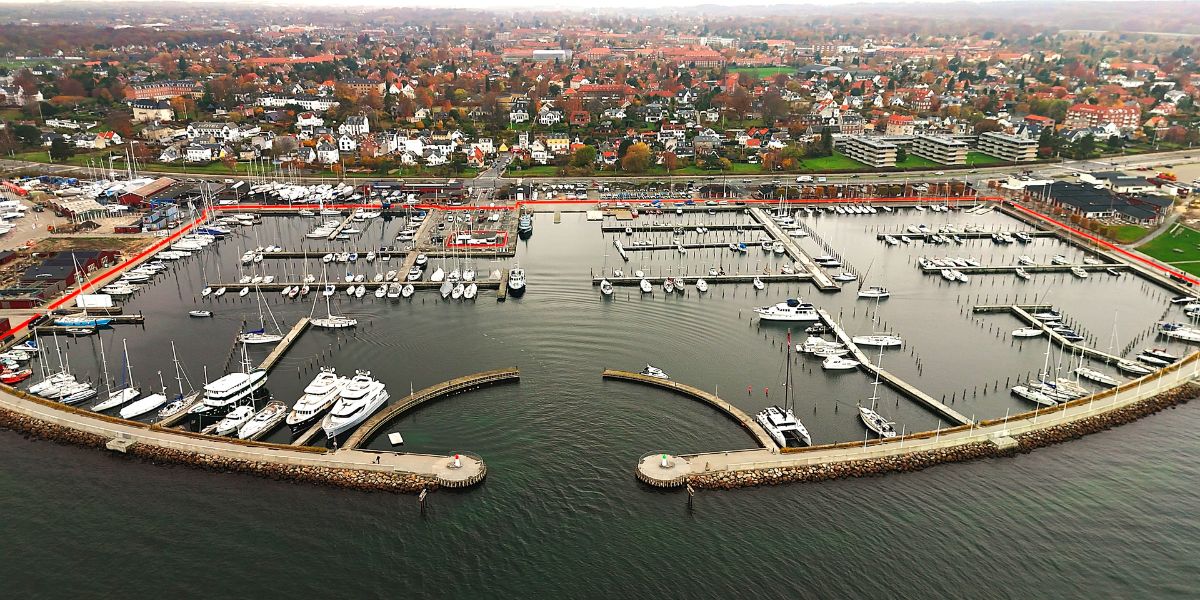
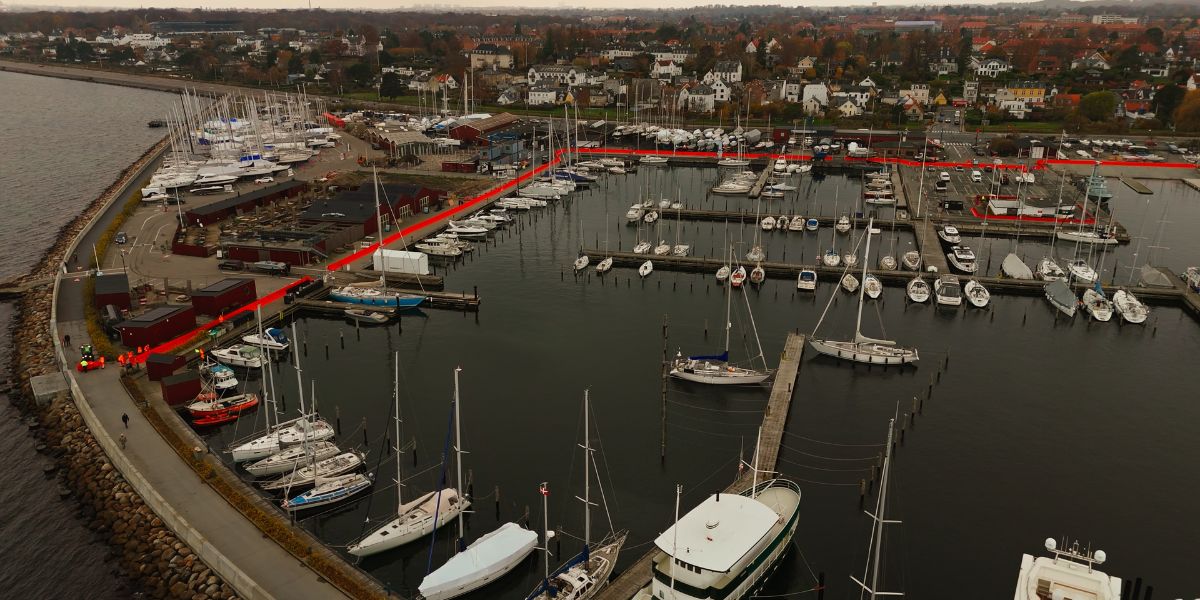

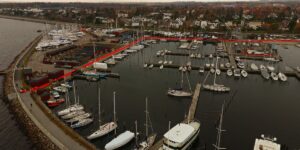







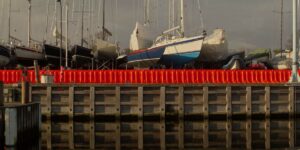
EasyWall has become an integral part of Gentofte’s broader flood-defense framework, working alongside other solutions like NoFloods Tube Barriers (known locally as “watertubes”) and complementing infrastructure work by partners including Oranje Beton, the Danish manufacturer based in Holstebro.
Want to Learn More About Our EasyWall Flood Barrier?
A Milestone in Climate Resilience
This deployment represents an important milestone in Gentofte Municipality’s journey toward comprehensive climate resilience, proving that efficient flood protection doesn’t require permanent infrastructure, years of construction or compromised harbor functionality.
Instead, it can be simple, fast and highly effective, ready to deploy in minutes and removed just as quickly when threats pass.
Transform Your Flood Response from Reactive to Proactive
The Skovshoved Harbor deployment tells a powerful story – you don’t have to wait years for permanent infrastructure to protect your property or community from storm surge and flooding.
Temporary water diversion barriers, when properly engineered and strategically deployed, provide the reliable protection coastal communities need to face an era of increasing storm intensity and rising sea levels.
EasyWall delivers serious protection at a fraction of the cost of permanent solutions, making it the ideal interim solution while long-term infrastructure plans are underway.
Is your property or community prepared for the next flood event?
The EasyWall water diversion barrier system delivers proven, rapid-response flood protection exactly when and where it matters most, with the same reliability trusted by forward-thinking municipalities across Europe.
Contact our team today for a customized flood-protection assessment.
We’ll help you understand your vulnerabilities, evaluate deployment scenarios and design a water barrier solution that protects your critical infrastructure – whether you need 100 meters or 1 kilometer of coverage.
Don’t wait for the next storm to test your preparedness – discover how EasyWall can transform your flood response from reactive scrambling to confident proactive protection.